
A holistic method to determining gem origin
In this last of this series on origin determination, Gubelin Gem Lab talks about “holistic” diagnosis of features that can differentiate gems coming from different sources but created under similar conditions.
The first article of the series on origin determination of gemstones emphasised the “ideal” case in which gems from different countries are found in distinct geological environments and have distinct gemmological properties, and thus determining the one single source is possible. However, when the geological and mineralogical conditions of the host rock during the growth of the gemstone were very similar in two different locations, a clear separation between the sources, and therefore the countries of origin, is difficult, sometimes even impossible. This issue was addressed in the second article of this series (see JNA, August 2006, p 52), pointing out as an example the possible overlap of gemmological properties found in selected types of blue sapphires from Sri Lanka and Ilakaka in Madagascar. Gubelin discusses here a holistic approach in addressing this challenge. The search for the diagnostic feature The overlap of properties of gemstones from various sources might create ambiguity and thus hinder the determination of the country of origin. The occurrence of such cases has been known for many years. To escape this dilemma, gemmological laboratories have performed extensive analysis, looking for a feature that would serve as a diagnostic property to allow an unambiguous differentiation between the two sources. For example, sapphires from the Kashmir region show properties that are also found in certain sapphires originating from Sri Lanka and also Madagascar. Both the Kashmir stones and the “Kashmir-like” sapphires from Sri Lanka or Madagascar have dust bands, flake-like inclusions and very similar spectral and chemical features. However, only Kashmir sapphires show inclusions of pargasite crystal, a sodium-rich variety of amphibole. Pargasite has not been found thus far in either Sri Lankan or Madagassian sapphires.
This makes pargasite a diagnostic property, i.e. one which is localityspecific for Kashmir origin. The search for this one diagnostic property was not always successful in many cases: the search for a diagnostic feature failed. When evaluated individually each gemmological property (inclusion scenario, chemical and spectral fingerprint, etc.) of some stones overlap with those from one or more other sources. The Gubelin Gem Lab therefore decided to take a different approach.Instead of looking for a single diagnostic feature, we believe that a comprehensive view of the entirety of features of a given stone is more meaningful. This comprehensive view takes as many features as possible into account and evaluates them collectively and simultaneously. A large number of properties, including the results from the identification and description of inclusions, the analysis of chemical elements and the collection of spectral properties, are considered. This approach is truly holistic1, and gives credit to the fact that each and every property of a gemstone is a consequence of its geological history. This holistic view of a gemstone results in a large number of observations. Typically, a standard gemmological analysis of a single stone yields from 10 to 50 observations. Their comprehensive evaluation is not a trivial task. Graphical descriptions of these observations are helpful only as long as the number of observations, i.e. the number of dimensions projected, is limited to two, three or four at maximum (the chemical diagrams shown in the previous article of this series constitute an example of a representation of twodimensional chemical data, e.g. one being the concentration of Fe2O3, the other that of TiO2).
It is next to impossible for the human brain to reasonably evaluate the double-digit number of observations generated in a standard analysis simultaneously as well as in a useful and reliable manner. Therefore, support in the form of statistical methods and computerised algorithms is required to handle the number of dimensions generated by the approach presented here. The Gubelin Gem Lab has started to develop and use methods and processes, including the customisation of sophisticated software, that allow for the processing and evaluation of such high numbers of observations. The concept of similarity While the use of advanced statistical methods and computer programmes is rather new, the underlying concept is long established, and has been applied for determining the origin of gemstones since the early days of Dr Gubelin. His concept is based on the comparison of a stone of unknown origin with stones of known origin. The comparison is done by determining their similarity, i.e. the degree of analogy and resemblance of gemstones from different mining areas. So far, this comparison has been done “manually,” based on the gemmologist’s experience and expertise.
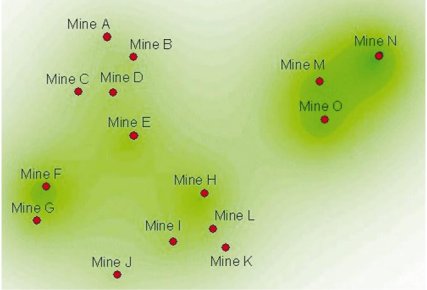
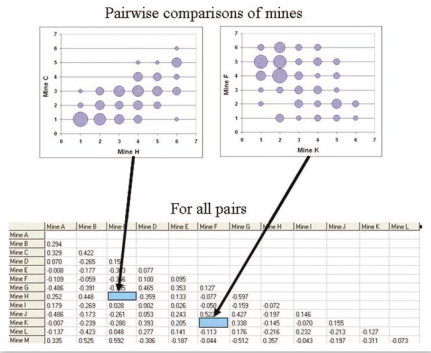
The Gubelin Gem Lab developed methods to translate this experience and expertise into an algorithm2. Figure 2 is a simplified and abstracted visualisation of pairwise comparisons of mines. The numbers 1 to 7 exemplify different observations, and the size of the circle represents the average similarity of the observation of samples from the two mines. The observations of each mine are compared with those of all other mines, and the results of these comparisons are projected in a similarity or proximity map. The closer one mine is located to another on this map, the more similar the gemstones are. The actual location on the map is arbitrary and meaningless; only the position of each mine in relation to all the other mines is important. The novelty presented here is not the concept of similarity as such, but its reproducible and quantified application, by translating the concept of similarity into an algorithm. This offers many advantages. First, the number of gemstones of which the origin can be determined, as well as the reproducibility and objectivity of the process, increases.
Other advantages are flexibility and scalability: the number of possible origins that must be considered increases constantly, as does also therefore the potential overlap of the gemmological properties of these gemstones. The system is capable of adjusting further to new analytical methods which might become available in the future. In order to determine the origin of gemstones, we particularly emphasise the need to consider the full range of observed properties, based on the fact that each property of the gemstone is a direct consequence of the geological mineralogical conditions of the surrounding host rock before, during and after the growth of the crystal. Observations should not be suppressed or masked, as this would result in a distorted interpretation of the geological reality present at the time of the growth of the gemstone. Repeatedly, some laboratories or gemmological institutions have made attempts to propose simpler methods of origin determination. These methods usually reduce the number of observations in order to bypass the multitude and diversity of features in a gemstone and to avoid the apparent complexity. Such simplified methods might have a potential for a phenomenological classification of gemstones, in order to describe certain types of appearances and looks of gemstones. However, they have nothing to do with the determination of the geographic origin or geologic source of a stone. Requirements for gem labs to do origin determination As we have shown, advanced statistical methods are needed to manage the more complex challenges of origin determination. The Gubelin Gem Lab has for some time been venturing into these methods, and will provide the gemmological community and gemstone industry with additional insights and applied solutions in the near future. We strongly believe that such methods will improve the quality and reliability of origin determination in coloured gemstones. These new developments will strengthen the credibility of the science of origin determination. Aside from these new methods and aside from obvious requirements such as the complete range of analytical equipment, some additional prerequisites are indispensable in order to determine a stone’s origin in a reliable and professional manner.
We postulate some conditions that we believe are sine qua non for origin determination. 1. Origin determination requires a complete reference collection of sample stones: This collection must contain a sufficiently high number of representative sample stones from all commercially relevant mining areas worldwide. It must also include stones from mines which are now exhausted, or which stopped production for other reasons. The permanent updating of this reference collection is both mandatory and difficult, keeping in mind the number of mines that are opening (or re-opening) every year on all continents. The Gubelin Gem Lab is in the privileged position of owning an uninterrupted collection of gemstones from virtually all relevant mines worldwide, from the 1930s until today. However, the resources required to maintain the collection are considerable. Last year alone, Gubelin staff and partners visited more than 100 mines in order to keep the collection up to date. The authenticity of these samples is of utmost importance. To get samples that are indeed from the mine you believe they are from is very difficult. Only rarely is it possible to collect the samples directly from the host rock in the mine. Mostly, one depends on mine owners and other individuals who can provide samples more or less directly from the source. Gathering samples from several independent people as well as multiple cross-checking are absolute requirements in order to have a sufficient level of confidence in a reference stone. Extreme care, caution and even mistrust are recommended before a sample can be incorporated into a reference collection.
For a gemmological laboratory, the likelihood of being intentionally “poisoned” (i.e. receiving stones from a source other than the one claimed by the seller or donator) is high, and this could have disastrous results. 2. Origin determination needs geological expertise: The operation of sophisticated technical equipment which today is omnipresent in gem labs, the analysis of gemmological properties and the correct and careful interpretation of the resulting data and observations alone exceed the level of knowledge taught in gemmological training. Further, origin determination requires a sound understanding of geological processes such as mineral growth, metamorphic and magmatic petrology and regional tectonic events, e.g. orogenesis. The interpretation of small-scale gemmological observations requires constant verification with the scientific models of large-scale geological environments. We recommend that most, if not all gemmologists at a gemmological laboratory involved in origin determination hold a degree in earth sciences (geology, mineralogy, petrology, crystallography or a related field). This academic foundation is completed by solid gemmological training and several years of experience in a gem lab in order to be able to take on the challenges of origin determination. A full understanding of the geology of all relevant gemstone mines worldwide demands a tremendous amount of research work. Most credible laboratories invest a certain amount of their resources in scientific research activities. The results of this research is used in-house but is also often shared with the geological and gemmological community by means of scientific publications. Considering the amount of time and other resources required to tackle all this scientific work, it is impossible for gem labs to fulfil this task alone. However, cooperation with full-time researchers and research organisations, such as universities and other professional research bodies, is an effective way of obtaining first-hand access to scientific results.