

Jewellery Passport
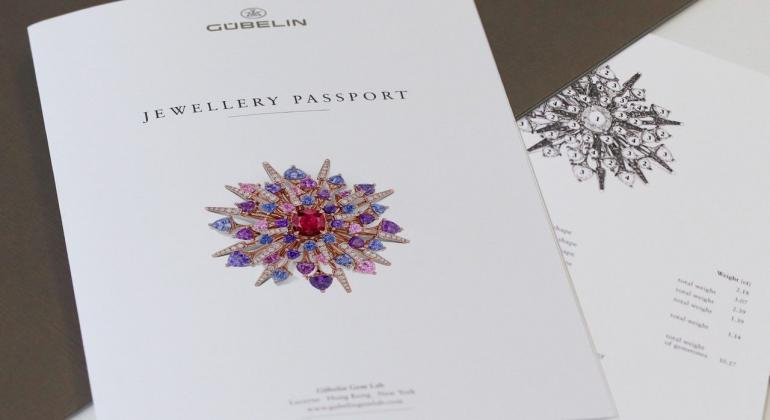
Gübelin Gem Lab Jewellery Passports are issued for jewellery items containing multiple gemstones, typically of different types. Gübelin Gem Lab Jewellery Passports are issued on the basis of a different, reduced standard of analysis as is applied on other Gübelin Gem Lab services. Thus Jewellery Passports are not subject to the same level of scrutiny as Gübelin Gemmological Reports. It is important to understand that Gübelin Jewellery Passports do not comply with the standards specified by the Gübelin Gem Lab Seal. Jewellery Passports differ from Gemmological Reports with regards to the depth, breadth, details and numbers of analyses. The detail of disclosure – specifically regarding authenticity and treatments – used in Jewellery Passports is also limited and simplified compared to Gemmological Reports. Owed to this reduced level of analysis and disclosure, the findings stated in a Jewellery Passport might not be consistent with the findings stated in a Gübelin Gem Lab Gemmological Report for the same item.
Gemstones are tested insofar as mounting permits. All weights are indicated by the client or as engraved on the jewellery piece. Pearls and diamonds, and possibly also some of the coloured gemstones, are not tested for natural origin, nor for origin of colour. Any metal identification is conducted at the surface only. For jewellery pieces containing between 26 and 100 gemstones, approximately 20% of the gemstones undergo testing. For jewellery pieces containing more than 100 gemstones, approximately 10% of the gemstones get tested.
The description given in the Jewellery Passport is limited to a selection of identifying characteristics observed in the gemstones. The findings mentioned in this Jewellery Passport reflect the state of the jewellery item as well as the gemstones at the time of examination and are not exhaustive. The unaltered original of the Jewellery Passport is the only valid document. The colour photograph on the first page of the Jewellery Passport serves merely as an illustration of the items under examination. The appearance of the items may differ from their photographic image. The black-and-white photograph on the second page of the Jewellery Passports indicates the stones that are outlined in the respective description underneath.
The identity and authenticity of gemstones are assessed by applying a limited range of analysis, and on a limited number of stones only, as specified above. In compliance with industry standards, the mention of a species and/or variety name implies a natural provenance. A gemstone found to be of synthetic (also referred to as lab-grown or manmade) provenance is disclosed as such, i.e. is preceded by the word ‘synthetic’. Note, however, that the level of analysis performed is restricted, and not all stones are tested. Thus, the fact that no synthetic gemstone is disclosed in the Jewellery Passport does not necessarily mean that such synthetics are absent.
As stated above, the authenticity of pearl is not tested in the framework of a Jewellery Passport, and it can be generally assumed that the term pearl on a Jewellery Passport implies a cultured pearl. Since the authenticity of diamonds is also not determined, the term ‘diamond’ on a Jewellery Passport can imply a natural or a synthetic provenance of the diamond.
Historically, many coloured gemstones have been enhanced to improve their appearance. Enhancement is a term used in the trade to describe any process additional to cutting and polishing that improves the appearance or durability of gemstones. Today, a variety of traditional and advanced enhancements (also known as treatments) are routinely applied to many natural gem materials including, but not limited to, beryl, corundum, tourmaline, topaz, zircon, zoisite, etc. In the framework of a Jewellery Passport, the presence or absence of a treatment is not determined, unless requested by the client. Thus, the fact that no enhancement is disclosed in the Jewellery Passport does not necessarily mean that such enhancement is absent. If treatment detection is requested, Gübelin Gem Lab applies a limited range of analysis only to determine the presence or absence of the types of treatments that are typically applied and detectable on the specific type of gemstones. In this case, treatment disclosure is made in general terms on the first page of the Jewellery Passport. The exact type of treatment, or the extent of treatment, however, is not determined, and hence also not disclosed.
Note that certain enhancements – such as especially low temperature heating and/or irradiation – cannot be detected, or can be detected only under special conditions. Any comments made regarding the presence or absence of enhancements will therefore only reflect Gübelin Gem Lab’s findings. A more detailed assessment and disclosure of the exact type of thermal treatment is only undertaken in the scope of a Gemmological Report. The Jewellery Passport does not constitute a guarantee for, or appraisal of, the jewellery item respectively gemstones described herein. Gübelin Gem Lab assumes no responsibility for any damage or loss, or claims by third parties, which may arise from the issuance, use or misuse of this Jewellery Passport. It is recommended to carefully read the document “General Terms &Conditions” available on our website www.gubelingemlab.com.
Jewellery Passport Number
19020250
Date: 30 August 2019

Item
A Gubelingemlab pendant consisting of forty faceted gemstones
comprising ruby, blue-violet sapphire, purple sapphire, pink sapphire
and numerous diamonds.
Setting
The gemstones are mounted in red gold.
Serial number
000204457
| No | Type | Shape | Weight | |
| 1) | One ruby | cushion shape | total weight | 2.18 |
| 2) | Sixteen blue-violet sapphires | triangular shape | total weight | 3.07 |
| 3) | Fifteen purple sapphires | triangular shape | total weight | 2.39 |
| 4) | Eight pink sapphires | triangular shape | total weight | 1.39 |
| 1.14 | ||||
| One hundred and seventy-seven diamonds | round | total weight of gemstones | 10.17 | |
| Total weight of item: 22 gr | ||||