

The Roots of Origin Determination
The Gübelin Gem Lab Ltd, in Lucerne, Switzerland, is largely responsible for developing the science of origin determination in gemstones. Pioneered by the late Dr Eduard Gübelin, origin determination triggered awareness of the different sources of gemstones, and gave these stones a certain prestige. In this series of articles, Gübelin sheds light on this field.
Gemstones, in particular rubies, sapphires, emeralds and diamonds, have always been associated with specific countries and mining localities by virtue of their outstanding beauty and quality. However, not only the visible splendour of a gemstone contributes to the distinction of a prominent source. The often tumultuous history and controversial fame
linked with many exceptional gemstones, combined with a relatively continuous production over decades or even centuries, have contributed greatly to the reputation of a few particular gem deposits. Names like Kashmir or Burma inspire images of adventure and romanticism and evoke their rich cultural history, lush countryside, grand architecture and fascinating foreign cultures. Such places have achieved near-mythical status. A pioneer in many respects, the late Dr Eduard Gübelin brought back to Switzerland, from his numerous field trips around the world, many gemstone specimens from known mines and locations, in order to study and document the various gem deposits he had toured. His passion for the inner, microscopic world of gemstones and his scientific knowledge and curiosity led him to systematically classify and characterise these samples on the basis of their microscopic features. This strict characterisation of gem deposits paved the way for additional gemmological information: the country of origin. In the early 1950s, Dr Gübelin began to determine the geographic origin of gemstones and to disclose this on the reports issued by
the Gübelin Gem Lab. These beginnings of origin determination triggered a growing awareness of the different mining sources.
The Gübelin Gem Lab remains largely responsible for the development of the science of origin determination in gemstones. We feel it is time for a retrospect on and an examination of the outlook for this field of gemmology. In the present and subsequent issues of Jewellery News Asia, the Gübelin Gem Lab will provide insight into origin determination. We will describe the methods and techniques implemented to determine the country of origin, as well as the technical and intellectual requirements needed to carry out origin determination in a consistent and reliable manner. We will also consider the limitations of origin determination and how to deal with today’s challenges in order to ensure that this service may continue to be offered to the trade and the public in the future.
Technical aspects
The aim of the origin determination procedure for coloured gemstones is to provide information on the geographic provenance of a particular stone.
This information is based on data obtained during the gemmological examination. We emphasise that all gemmological testing methods must be non-destructive (or at least “quasi non-destructive,” as is, for example, the use of a laser beam for the laser ablation method or LA-ICP-MS, which leaves a small crater of up to 200 microns in size on the surface of the stone).
The most important gemmological-mineralogical criteria used for the characterisation of gemstones are:
1. Inclusion features (cavity fillings1, growth features,
solid inclusions)
2. Chemical fingerprinting (major, minor and trace elements)
3. Spectral fingerprinting (UV-Vis-nIR – range2)
4. Optical properties (refractive indices, birefringence)
Depending on the type of gemstone and the information required, the following criteria reveal additional information:
5. Infrared characteristics
6.Luminescence behaviour The gemmological-mineralogical properties of a gemstone are always – directly or indirectly – controlled by the genetic environment in which it was formed. The most relevant factors during natural gemstone formation are:
(i) the nature of the host rock;
(ii) “interactive events” between the host rock and the neighbouring rock units (e.g. exchange reactions involving the migration of fluids, thus introducing or taking away chemical components necessary or unwanted for the growth of a gemstone); (iii) pressure and temperature conditions; and
(iv) composition and nature of solutions/liquids responsible for the dissolution, transport and precipitation of the (chemical) components involved in crystal growth.
As mentioned before, origin determination in the trade implies the indication of the geographic provenance of a gemstone. Principally, this is done by comparing the features of the unknown gemstone with the properties of samples from a precisely documented and interpreted reference collection.
Hence, it is a key requirement to have access to a complete collection of authentic reference samples and analytical data for all economically relevant mining areas worldwide. These samples have been minutely analysed, their gemmological properties are fully documented and their geologic-genetic environment is known. Actual origin determination consists firstly in the collection of all relevant data regarding the criteria mentioned above for a given stone and comparing this with the data from the reference collection stones, i.e. stones from a known source. Thus, origin determination is:
a) the attribution of a stone to a specific geological-genetic environment (or a specific type of deposit);
b) the attribution of a stone to a mining area, i.e. a geographic locality or country. Origin determination is only possible because the properties of a gemstone observed and measured in the laboratory reflect the specific conditions of its genetic background during the natural crystallisation process.
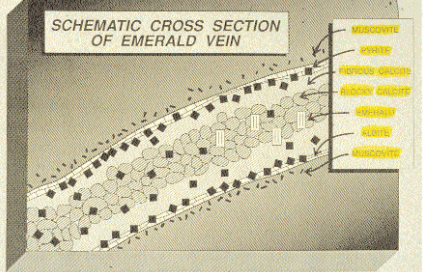
We would like to illustrate the “origin philosophy” by presenting a case study. Case study A: Emeralds from Colombia and Brazil Let us first take a look at emeralds from two different localities in South America: the famous Colombian emeralds, which are found in the socalled black shales of the Cordillera Oriental, and emeralds originating in the Santa Terezinha mining area in Goias, Brazil. The black shales of the Colombian deposits are folded or broken up with breccias of carbonates, albite and/or pyrite and fractured bits of black shale. The emeralds (often over 10 cm in size) are formed free standing inside vugs of breccias and fissures in black shale. The vugs are lined with crusts of calcite, pyrite, albite and sometimes green muscovite. In Santa Terezinha, the emeralds are disseminated in phlogopite schists and phlogopitized carbonate-talc schists. Emerald-rich
zones are encountered mainly in the core areas of shear folds and along foliation planes. It is evident that the genetic-geological background of emeralds from Colombia is completely different to those of Brazil. Knowing that the most important characterisation criteria are reflected in the different natural growing conditions, it is no surprise that the mineralogical-gemmological characteristics for emeralds from these two mining areas are completely different.
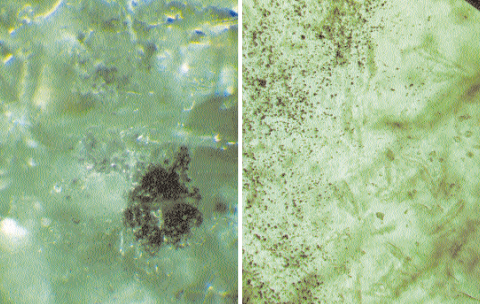
(1) Inclusion features Colombian emeralds are famous for containing the classic “slg” 3- phase fluid inclusions consisting of a solid, a liquid and a gaseous phase. Besides the typical fluid inclusions, they generally display pronounced growth features (parallel to the basal faces, to prism and pyramidal faces). Common solid inclusions in Colombian emeralds are carbonates, quartz, feldspar, pyrite and small black particles from the surrounding black shales. The members of the mineral association in the emerald-bearing veins are mainly carbonates, feldspar, quartz, pyrite and muscovite, hence practically all vein minerals are also present as inclusion minerals. An analogous situation obtains for the Brazilian Santa Terezinha emeralds. Their hosts are schist-type rocks composed mainly of mica, carbonates, talc and different so-called accessory minerals such as ironchromium spinel, pyrite and rutile. As a logical consequence, these minerals are all common solid inclusions in emeralds from the Santa Terezinha mining area. Growth features and fluid inclusions are, of course, also observed, but in terms of size, intensity and variability, they are much less developed than in their Colombian counterparts. The relationship between the internal features (especially the solid inclusions) and the genetic environment of a gemstone is, in general, quite evident. However, this relationship becomes clear also when comparing other properties such as chemical and/or spectral fingerprinting.
(2) Chemical fingerprinting From a chemical point of view, Colombian emeralds are characterised by relatively low contents of foreign elements such as sodium (Na), potassium (K), magnesium (Mg), rubidium (Rb), caesium (Cs) and iron (Fe). The colouring elements chromium (Cr) and vanadium (V) are present in varying amounts. On the other hand, Brazilian emeralds from the Santa Terezinha mining area belong to the group of emeralds that contain the highest concentrations of foreign elements known in different localities all over the world. Their combined weight can make up as much as 6 to 7 percent of the total weight (when calculated as oxides: Na2O + MgO + etc.)
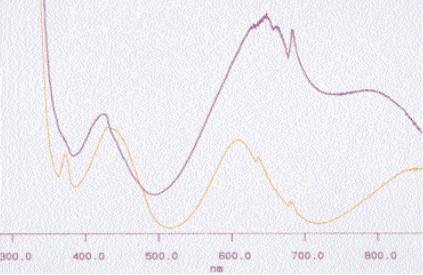
(3) Spectral fingerprinting The spectral fingerprints of Colombian and Santa Terezinha emeralds are also very different from each other. Colombian emeralds (with very few exceptions such as the Trapiche type) have absorption spectra dominated by two broad [Cr + V]3+ bands. Iron-related absorption features (a narrow band around 370 nm and broad bands in the yellow to red/nIR region) are generally absent On the other hand, in emeralds from the Santa Terezinha region, the iron-related absorption features are normally quite strong.
(4) Optical properties
The values for the optical properties (refractive indices, birefringence) are mainly controlled by the nature and the amount of foreign elements incorporated into the emerald structure during its natural formation. Considering the fact that emeralds from Santa Terezinha have, in general, very high foreign element concentrations, and the Colombian emeralds normally have only low contents of these elements, we would expect high optical values for emeralds from Santa Terezinha and low values for emeralds from the Cordillera Oriental. The diagram in Figure 7 shows that this assumption is correct: the Colombian emeralds are located in the lower left part of the diagram, whereas the representative point for the Brazilian emeralds from Santa Terezinha is situated in the upper right corner of the diagram. Comparing the nature and type of the different rocks hosting the emeralds in the Colombian Cordillera Oriental (the black shales providing the colour agents chromium and vanadium) and the Santa Terezinha mining area in Brazil (metamorphic schists with high contents of elements like iron, magnesium, sodium, etc.), the differences regarding the main mineralogical-gemmological properties of the emeralds originating from these rocks may be easily explained. Whilst the inclusion scenarios are mainly controlled by the mineralogical composition of the host rock (which determines the internal association of solid inclusions) and the growth conditions (responsible for the formation of cavities and their fillings and for growth features), most of the other properties of the emeralds may be related to the chemical elements, which were available during their growth history.
1 This term comprises natural fillings with in the gemstones, such as fluid inclusions, and must not be confused with fillings of open cavities and fissures due to man-made treatments 2 Approximate spectral ranges used in gemmology: Ultra-violet: 280-390 nm; Visible range: 390-780 nm; near Infrared: 780-1400 nm